IB Mission Statement
The International Baccalaureate aims to develop inquiring, knowledgeable and caring young people who help to create a better and more peaceful world through intercultural understanding and respect.
To this end the organization works with schools, governments and international organizations to develop challenging programmes of international education and rigorous assessment.
These programmes encourage students across the world to become active, compassionate and lifelong learners who understand that other people, with their differences, can also be right.
The IB Diploma Programme
The IB Diploma Programme (DP) is a challenging two-year pre-university curriculum, primarily aimed at students aged 16 to 19.
It leads to a qualification (the IB diploma) that is widely recognized by the world's leading universities.
Composition of the Diploma Programme
The curriculum contains six subject groups, together with the DP core.
The mainstream subject groups and the core elements are shown in figure 1.
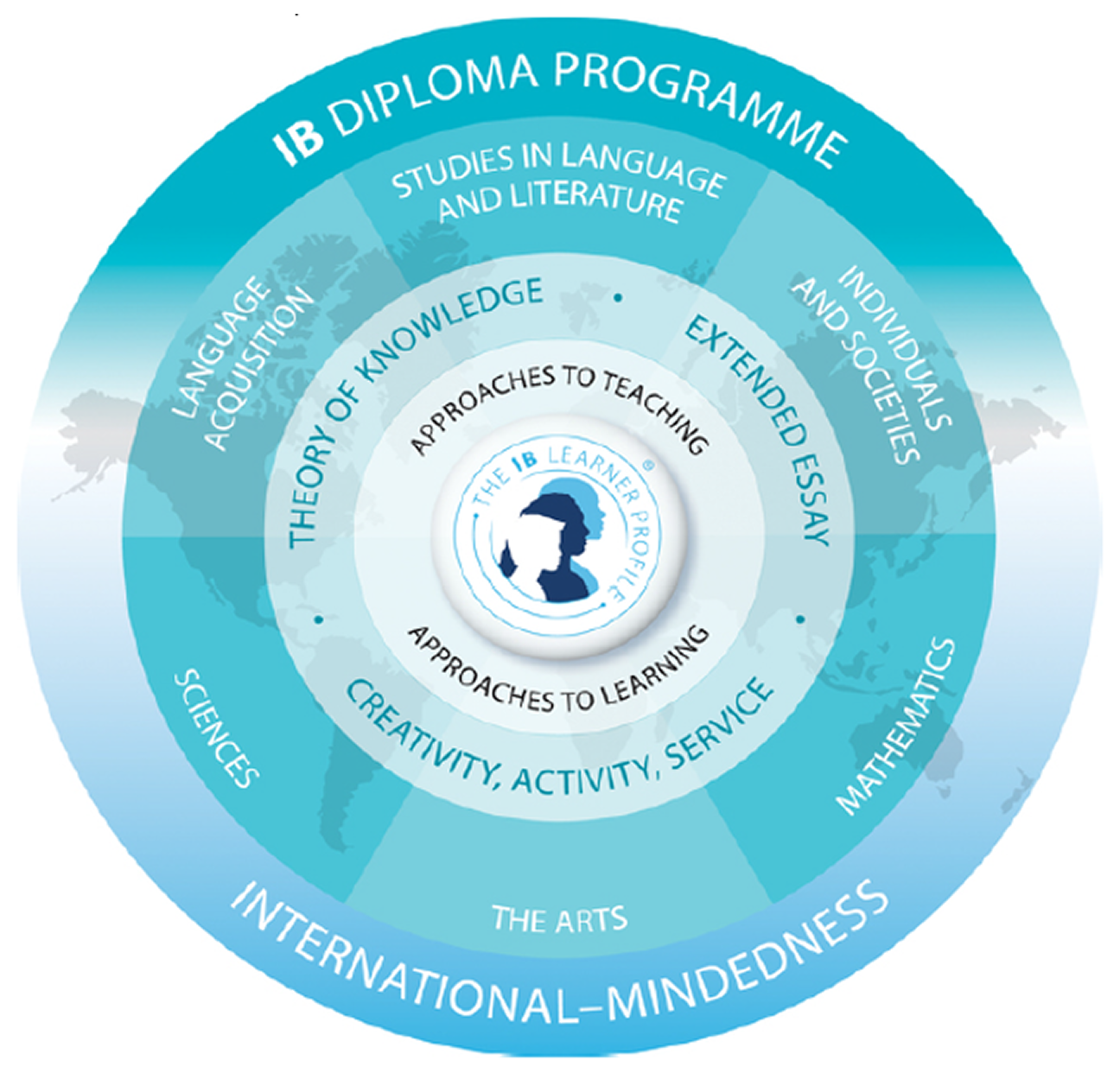
Figure 1: Diploma Programme Model
| Subject Groups |
| 1. Studies in Language and Literature |
| 2. Language Acquisition |
| 3. Individuals and Societies |
| 4. Sciences |
| 5. Mathematics |
| 6. The Arts |
| Core Elements |
| Extended Essay |
| Theory of Knowledge |
| Creativity, Activity, Service |
List of Subjects Offered at DPSI Ghana
| 1 |
2 |
3 |
4 |
5 |
6 |
- English A: Language & Literature (SL & HL)
|
- French B (SL)
- Spanish ab initio
|
- Geography (SL & HL)
- Economics (SL & HL)
- Business Management (SL & HL)
|
- Physics (SL & HL)
- Chemistry (SL & HL)
- Biology (SL & HL)
- Design Technology (SL)
- Computer Science (SL & HL)
|
- Math AA (SL & HL)
- Math AI (SL & HL)
|
|
Subjects to be Studied by DP Category Candidates
Mainstream Subjects
DP category candidates taking the diploma study six subjects selected from the subject groups.
Normally one subject from each group with three of these studied as higher level (HL) and three studied as standard level (SL).
- HL courses represent 240 teaching hours.
- SL courses represent 150 teaching hours.
Core Elements
All three core elements must be studied; these are central to the philosophy of the DP.
The three core elements are:
- The Extended Essay (EE)
- The Theory of Knowledge (TOK)
- Creativity, Activity, Service (CAS)
The Extended Essay (EE)
The (EE) offers students the opportunity to research and investigate a topic that interests them, using the independent research and writing skills they will need at college or university.
A diploma candidate must complete and submit an extended essay (EE), which is a substantial piece of independent research of up to 4,000 words.
Work on the EE is expected to occupy approximately 40 hours. The work for an EE must be done under the direct supervision of an appropriate teacher at the IB World School that is registering the candidate for the examination session.
The Theory of Knowledge (TOK)
The TOK course explores the nature of knowledge across a range of disciplines. A diploma candidate must follow a theory of knowledge (TOK) course.
The IB recommends that TOK is an independent course of at least 100 teaching hours evenly distributed over the two-year period of study, and the course must meet the TOK assessment requirements that include giving a presentation and submitting an essay on one of the six prescribed titles for the examination session.
Creativity, Activity, Service (CAS)
The CAS programme fosters students' awareness and appreciation of life beyond the academic arena.
A diploma candidate must take part in creativity, activity, service (CAS) experiences.
Schools entering candidates for the diploma undertake to ensure that all candidates engage in a CAS programme.
The CAS programme formally begins at the start of the DP and continues regularly, ideally on a weekly basis, for at least 18 months with a reasonable balance between creativity, activity and service.
Award of the Diploma
DP category candidates must study six subjects, plus the three core subjects—EE, TOK and CAS. They must accumulate no fewer than 24 points from assessment in these subjects, in addition to grade stipulations.
- They must meet all of the requirements within a maximum of three examination sessions.
- Candidates who successfully meet these conditions will be awarded the diploma.
- Candidates who take the diploma in multiple languages may be eligible for a bilingual diploma.
Benefits for Students
IB learners are:
- Encouraged to think critically and creatively, and solve complex problems
- Drive their own learning
- A core part in educational programmes that can lead them to some of the highest-ranking universities around the world
- More culturally aware through the development of a second language
- Able to engage with people in an increasingly globalized, rapidly changing world
How Can I Learn More About the IB and DP?
- Visit the IB website at www.ibo.org
- Attend school meetings and events
- Speak with your school's DP coordinator
- Speak with your child's DP classroom teachers